MBI team
November 26, 2026 · 8 min read
An AI Champion is an employee who helps colleagues bring AI into their daily work, builds shared team skills and looks after the team's AI agents after the outside partner steps back. One Champion in each team is what makes AI adoption last after the training day.
An AI Champion is an employee who helps colleagues bring AI into their daily work, builds shared team skills and looks after the team’s AI agents after the outside partner steps back. One Champion in each team is what makes AI adoption last after the training day.
Instead of relying on one company-wide workshop, a Champion gives colleagues help at their desk, keeps the team’s knowledge current and shows leadership what changed.
“Adoption doesn’t happen in a training room. It happens at one person’s desk, when their own work gets easier.”
Leoš Gerlich, Head of Growth, MBI
Why isn’t a company-wide AI training day enough?
General AI workshops create short-term enthusiasm, but the practical questions come days later: on a Tuesday afternoon, in the middle of a real deadline. When nobody nearby can help with the prompt or workflow right away, people go back to the old way, or paste work into private ChatGPT accounts, which is how shadow AI starts.
Training internal AI Champions removes that dependency. Instead of relying on outside consultants for good, every team has a colleague who understands both the AI tools and the team’s own work.
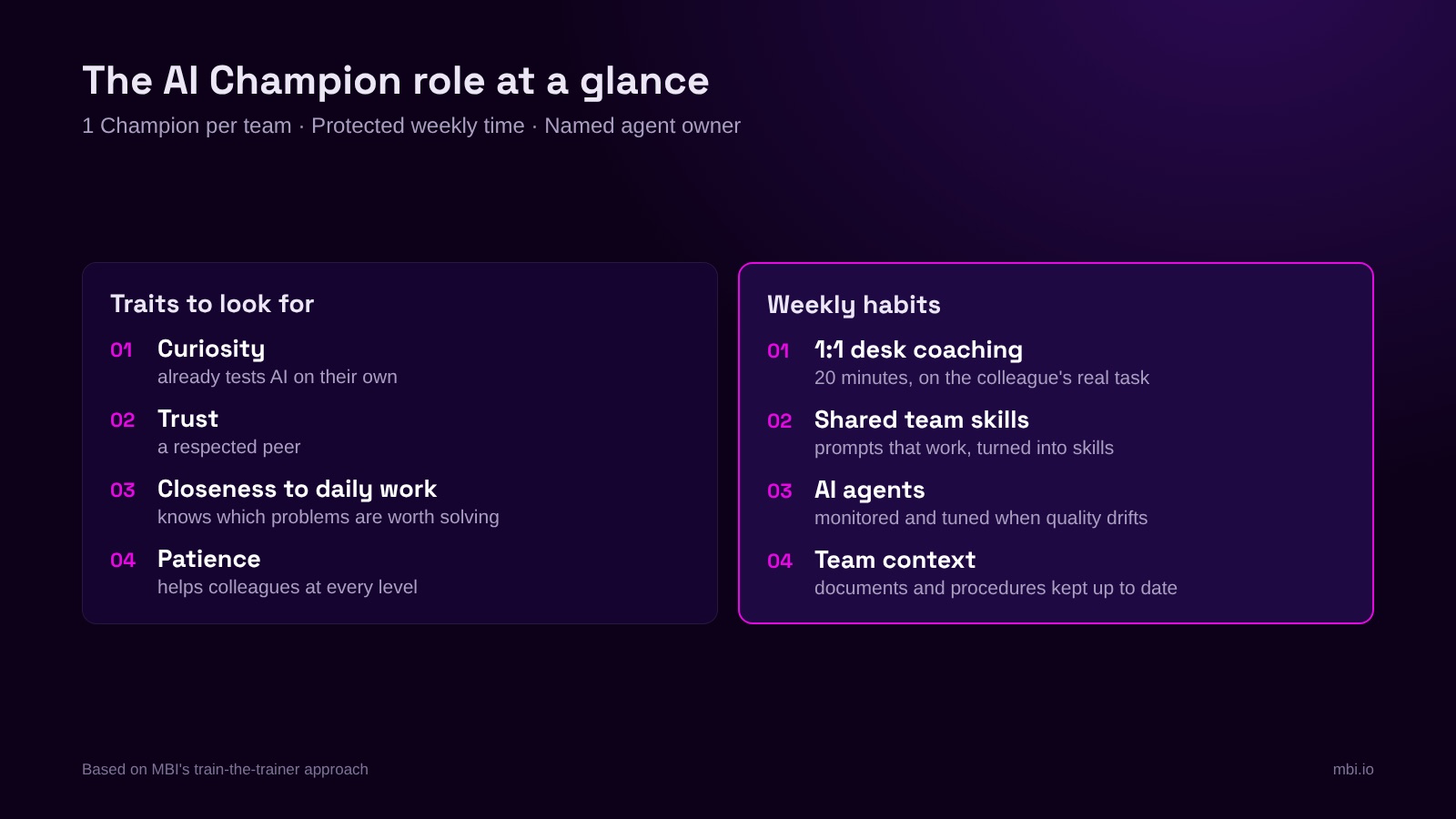
The AI Champion role at a glance
What do AI Champions do week to week?
- Coach colleagues one to one. Champions answer everyday questions, sit with a teammate for 20 minutes, and show how to do that exact task faster with AI.
- Turn individual wins into shared skills. When someone finds a prompt or workflow that works, the Champion turns it into a shared team skill, so it doesn’t stay in one person’s account.
- Own and monitor the team’s AI agents. Every AI agent in daily use needs a named owner. Champions check the agent’s results, adjust its instructions when the quality drifts, and switch off agents that stop adding value.
- Keep the team’s context current. AI is only as good as the information it can see. Champions keep team documentation, procedures and reference files accurate and up to date.
- Track and share the impact. Champions follow how the team uses AI and report concrete time savings to leadership, which shows the return and shows colleagues what’s possible.
- Raise problems early. When a connection breaks, a rule slows work down, or people avoid a tool, Champions flag it before the team invents its own workarounds.
Who makes a good AI Champion?
The best AI Champion is rarely the most technical person in the building. Good Champions share four traits:
- Curiosity: they already try AI tools on their own.
- Trust: colleagues respect them and feel comfortable asking for help.
- Closeness to the daily work: they know the team’s tasks and can see which problems are worth solving.
- Patience: much of the role is helping colleagues with very different levels of experience.
MBI usually spots these people in week 1 of an AI Discovery Assessment, during the interviews. They’re the people teammates already go to for help.
How many AI Champions does a company need?
A good rule is one AI Champion in each team that works with AI. In MBI transformation programmes, two to four of them also take a deeper track covering how the platform is run, how agents are designed and how to train others. They’re the people the whole AI setup is handed over to at the end of the project.
What support do AI Champions need from leadership?
- Protected time. If the Champion role comes on top of a full workload, it’s the first thing dropped in a busy week. Agree fixed weekly time with their manager up front.
- Deeper, hands-on training, built on their team’s real work and data.
- A mandate from leadership, so their improvements and shared skills are actually adopted by the team.
- Visible recognition. Credit Champions by name when their workflow saves the team hours.
Whether the role comes with extra pay is up to your company. Protected time and visible backing from leadership are what it can’t do without.
Amazing Places: how AI Champions helped reach 97% adoption
During the three-month transformation at Amazing Places, MBI focused on training internal AI Champions instead of running general lectures for the whole company. The Champions learned to build workflows, look after agents and coach their colleagues.
By the end of the programme, 97% of employees used AI actively and 82% used it every day. Today the Champions run it in-house: they train new colleagues and extend the setup without outside help.
Five common mistakes when launching AI Champions
- Choosing by job title. Naming the IT manager by default rarely works. Choose by curiosity and trust.
- No protected time. “Do it when you have a spare moment” means it never happens.
- Responsibility without a mandate. If leadership ignores their suggestions, Champions stop making them.
- Naming them at handover. Champions should be part of the transformation from day one, not handed the setup on the last day.
- Keeping the wins invisible. If nobody shares the time saved, the energy fades.
How to launch AI Champions in 6 steps
- Pick one Champion per team, based on curiosity, trust and knowledge of the daily work.
- Agree their weekly time in writing with their manager.
- Train them first and in depth, on their team’s real workflows.
- Give every AI agent a named owner, usually the team’s Champion.
- Bring the Champions together every two weeks to share the skills that work across teams.
- Report time saved and AI use to leadership every month.
Frequently asked questions
What is an AI Champion?
An AI Champion is an employee who helps colleagues use AI in their daily work, builds shared team workflows, looks after the team’s AI agents, and keeps adoption going after the outside partner leaves.
What does an AI Champion do?
They coach colleagues one to one, turn prompts that work into shared team skills, monitor and adjust the team’s AI agents, keep team knowledge current, and report time saved to leadership.
Who should be an AI Champion?
Someone curious who already uses AI, is respected by the team and works close to the daily work. They don’t need a technical or IT background.
How many AI Champions does a company need?
One in each team that works with AI is a good rule. In a company-wide transformation, two to four of them take a deeper track and take over the whole AI setup at handover.
Should AI Champions be paid extra?
Extra pay is optional and up to your company. Protected time agreed with their manager and visible recognition from leadership matter much more.
What happens if an AI Champion leaves?
Because Champions write down their workflows and build shared team skills rather than private prompts, the knowledge stays with the team. Pick a successor early, ideally a teammate who already works with them.
Get new articles by email
Practical guides on making AI work in your company, from the MBI team. Unsubscribe anytime.
Thanks, you're subscribed.
That didn't work. Please try again, or write to [email protected].
Privacy policy