MBI team
November 20, 2026 · 11 min read
Shadow AI is AI that people use for work without the company knowing or controlling it, usually ChatGPT or similar tools on private accounts. Banning it rarely works, because people go around the ban; what works is giving them a better option: one governed AI layer, in your own environment, that is easier to use than the workaround.
If your company hasn’t rolled out AI officially, you almost certainly have shadow AI already. People don’t use private accounts to break rules. They use them because the tools help, and nobody gave them anything better.
“If your people use AI on their personal accounts, you already have an AI strategy. The question is whether it’s the one your company needs.”
Petr Volf, CTO and co-founder, MBI
How common is shadow AI?
Very. In Microsoft and LinkedIn’s 2024 Work Trend Index, 75% of knowledge workers said they already used generative AI at work, and 78% of those AI users were bringing their own AI tools to work. More than half of the people using AI at work were reluctant to admit using it for their most important tasks.
In other words, most of the use is there, and much of it is hidden. The question for a company is not whether people use AI, but whether the company can see it, steer it and build on it.
Five signs you already have shadow AI
- Some people’s output got noticeably faster, and nobody quite knows why.
- You see AI-style text in emails, proposals or reports, but the company has no AI tool.
- People ask IT whether they can use “that one tool” for a specific task.
- Expense claims or card statements include AI subscriptions.
- When you ask who uses AI, the answer is a polite silence.
In the five levels of AI maturity, this is level 1: people trying AI on their own, while the company works as before.
What shadow AI looks like, team by team
| Team | Typical shadow AI | The governed version |
|---|---|---|
| Sales | Prospect research and follow-up emails in a private chat, CRM notes copied in by hand | AI reads the CRM and past emails, drafts the follow-up, the salesperson approves it |
| Marketing | Posts and campaign copy written in a private account, brand rules pasted in every time | AI knows the brand guide and past campaigns, drafts in the house style |
| Customer support | Customer emails pasted into a chat to draft a reply | A draft reply is ready in the ticket before the agent opens it, built from the ticket history and the knowledge base |
| Finance | Invoice data or spreadsheets uploaded to summarise or check | Invoice data extracted inside your environment, edge cases sent to a person |
| HR | CVs and performance notes pasted in for summaries | Confidential by default: personal data stays in your own environment, with clear rules |
| Development | Code pasted into a chat, or AI coding tools on private licences | Agents work on the code with the same access rules as developers, every change reviewed |
The pattern is the same everywhere: people move company data to the AI by hand. In the governed version, AI comes to the data, inside your environment, with the right access.
The real risks
Data. Nobody knows which customer, financial or personal data went into which tool, under which terms. Under GDPR, the company is responsible for personal data its people process, whichever tool they use.
No record. When something goes wrong, there is no log of who asked what, and what the AI produced.
Lost value. The time people save stays invisible. The company can’t measure it, build on it or share what works between teams.
Know-how leaving. The prompts and workflows that work best live in private accounts. When the person leaves, they leave too.
Regulation. Under the EU AI Act, companies that use AI must make sure their people have enough AI literacy (this has applied since February 2025), and transparency duties, such as labelling AI-generated content and chatbots, apply from August 2026. Shadow AI makes both hard to show. Check the details that apply to you with your lawyer.
Agents raise the stakes
So far, most shadow AI is chat: people ask, AI answers, people copy the result. The next wave is agents, tools that act on their own: they read inboxes, update systems, send messages. An agent connected to company systems through a private account is a much bigger risk than a chat window, because it doesn’t just see data, it changes things.
That is why every agent needs the same rules as a person: limited access, a log of what it does, and a named human owner who is accountable for it.
Why bans fail
People go around a ban when the banned tool saves them an hour a day. The use doesn’t stop; it just becomes harder to see, and many people already hide it.
A ban also tells your best people that the company is behind, which is the opposite of what you want. The people using AI on their own are usually the ones you most need on your side when you roll it out properly.
Shadow AI vs governed AI
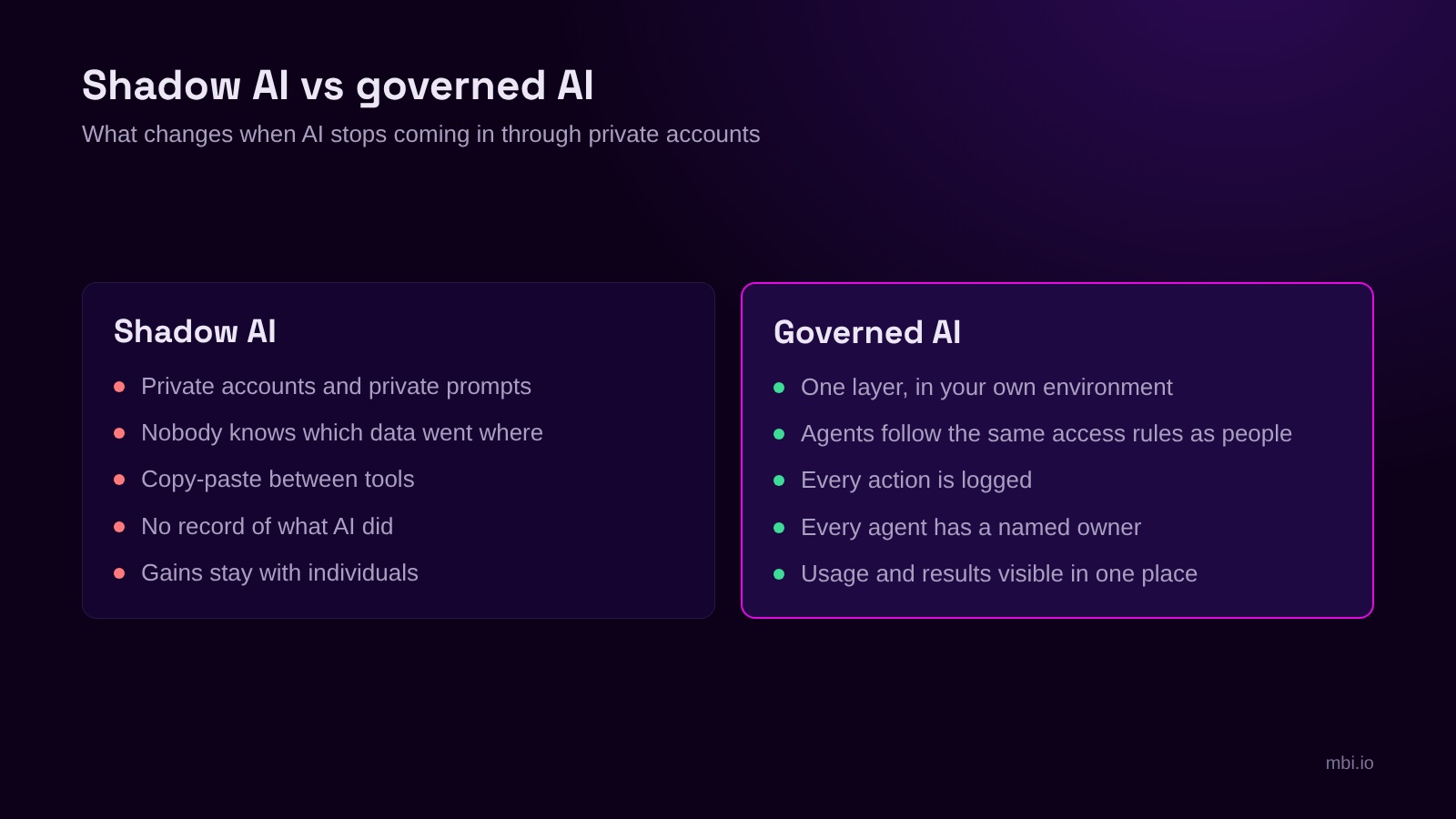
The alternative is one governed AI layer over the systems the company already uses. This is how we govern AI in client projects:
- Everything runs in your environment. Your data stays with you.
- Agents follow the same access rules as people. An agent sees only what its owner is allowed to see.
- Risky actions are blocked by design.
- Every action is logged, so you can see who did what, and why.
- Every agent has a named owner who is accountable for it.
- Usage, adoption and cost are visible in one place.
Is a company licence enough?
Buying company licences for ChatGPT, Copilot or Claude is a good first step: the data is covered by a business contract, and you know who has access. But on its own it usually moves a company from level 1 to level 2, not further. AI is now official, but it still can’t see your documents, history or systems, so people keep pasting data in by hand, and the answers stay generic.
When the official tool is less useful than the private one, people drift back.
How to make people switch
People switch when the company option is better for their own work. In practice that means:
- Connect it to their systems. AI that can read the ticket history, the CRM or the shared drive is more useful than any private account.
- Start with the people who use AI most. They know what works, and they become your first champions.
- Write the processes down first, so AI has something to work with.
- Make it safe to share. Ask people to bring the workflows they already built, and credit them for it.
- Measure adoption, not licences: how many people use it, how often, and for what.
From private habit to company workflow
The journey usually starts with one person and a chat window. Václav Vítek, Head of Growth at Amazing Places, describes how it went for him during the company’s transformation:
“At the start I used AI as an alternative to Google. Now I have schedules that find contacts on LinkedIn for me.”
Václav Vítek, Head of Growth, Amazing Places
That is the whole point of replacing shadow AI. The goal is not to take AI away from people like Václav. It is to move them from a private chat window to scheduled, repeatable work that the company can see, measure and share with everyone else.
What governed use looks like in practice
Before the project, AI at Kalorické tabulky was used by individuals, not built into any workflow. In three months, AI use moved into one governed setup connected to the company’s systems, where request metadata is visible and logged. Over the same three months, the share of people using AI at least 7 times a week rose from 48% to 97%.
“Banning AI doesn’t work. People are smart, they’ll find their own way to use it anyway. It’s better to set up a secure framework in which they can use it fully. Which of those two paths is your company on?”
Petr Volf
What to put in a one-page AI usage policy
Keep it short enough that people actually read it. We’ve made a template you can fill in: download the one-page AI usage policy template (free PDF).
- Which tools are approved, and for what.
- Which data may go where (see the three classes below).
- What always needs a human check before it leaves the company: anything sent to a customer, anything with numbers, anything legal.
- How to request a new tool, and who decides.
- Who owns each agent, and how to report a problem.
- Where to get help and training.
A simple way to classify data
| Class | Examples | Where it may go |
|---|---|---|
| Public | Website texts, published prices, press releases | Any approved tool |
| Internal | Processes, internal documents, project notes | Only approved tools under a business contract |
| Confidential | Personal data, customer data, contracts, finance, source code | Only inside your own governed environment |
Common mistakes when replacing shadow AI
- Banning first, offering later. Use goes underground, and the people who were furthest ahead feel punished.
- Choosing tools before identifying use cases. Start by understanding your business needs and identifying where AI can deliver the most value. Then select the tools that best support those use cases.
- Rolling out licences without connecting systems. See “Is a company licence enough?” above.
- Writing a 20-page policy. Nobody reads it. One page that people follow beats a long one they don’t.
- Treating it as an IT project only. Shadow AI is a sign that people want to work differently. That is a business decision, with IT and security as partners.
A first-week checklist for a CTO
- Find out what’s in use. Ask teams openly which AI tools they use and for what, and make it safe to answer honestly.
- Classify your data into the three classes above.
- Write the one-page AI usage policy.
- Start a tool register and an approval process for new tools.
- Pick one governed setup and connect it to the systems people need.
- Give every agent an owner, and log what it does.
- Train people, and keep records of who was trained. It helps with AI literacy under the EU AI Act.
What to tell your team
How you announce the change decides whether people bring their AI use into the open or hide it better. A short, honest message works best. For example:
“We know many of you already use AI in your work, and that’s good. We want to make it official, safer and more useful: one setup connected to our systems, with clear rules on what data can go where. Over the next weeks we’ll ask what you already use and what works for you. Nobody will get in trouble for what they’ve used so far. Bring your best workflows, and we’ll build on them together.”
Send it from the CEO or the business leader, not only from IT. It makes clear this is about how the company works, not about catching people out.
Frequently asked questions
What is shadow AI?
Shadow AI is AI that people use for work without the company knowing or controlling it, usually ChatGPT or similar tools on private accounts.
Should we ban ChatGPT at work?
Bans rarely work, because people go around them when the tool saves them time. It works better to give them a governed option that is easier to use than the workaround.
Is using ChatGPT on private accounts a GDPR risk?
It can be. If people paste personal data into tools the company hasn’t approved, the company may not know where that data went or under which terms. Check your situation with your data protection officer or lawyer.
Is a company ChatGPT or Copilot licence enough?
It is a good first step, because the data is covered by a business contract. On its own it usually doesn’t connect AI to your systems, so answers stay generic and people may drift back to private tools.
How do we find out which AI tools people use?
Ask openly and make it safe to answer honestly. Then keep a register of approved tools and an approval process for new ones.
Who should own AI governance?
The business, with IT and security. Every agent should have a named owner who is accountable for its access, its outputs and its tuning.
How long does it take to replace shadow AI?
A 2-week AI Discovery Assessment shows what is in use and where AI would pay off most. Moving the whole company to one governed setup is part of an AI transformation, which usually takes 3 to 4 months for a company with 30 to 500 people.
Get new articles by email
Practical guides on making AI work in your company, from the MBI team. Unsubscribe anytime.
Thanks, you're subscribed.
That didn't work. Please try again, or write to [email protected].
Privacy policy