MBI team
November 26, 2026 · 7 min read
An AI Discovery Assessment by MBI is a fixed-scope, two-week diagnostic for companies with 30 to 500 employees. In week 1, MBI interviews every team in scope and sets a baseline from your systems. In week 2, every use case is scored, ranked by return and turned into a roadmap leadership can fund.
An AI Discovery Assessment by MBI is a fixed-scope, two-week diagnostic for companies with 30 to 500 employees. In week 1, MBI interviews every team in scope and sets a baseline from your systems. In week 2, every use case is scored, ranked by return and turned into a roadmap leadership can fund.
It shows where AI pays off before any software licences are bought, and the roadmap stays with you whether or not you continue with MBI.
“Every engagement we run starts the same way. Two weeks, before anyone talks about tools.”
Leoš Gerlich, Head of Growth, MBI
Why start with a two-week assessment instead of buying AI tools?
Most mid-sized companies already experiment with AI tools, yet leadership still lacks answers to three core questions:
- Which specific workflows will save measurable time or money?
- What will implementation realistically cost in time and budget?
- Who inside the organisation owns the outcome?
Buying licences before answering these questions leads to scattered adoption. A two-week diagnostic answers all three without locking the company into a multi-month transformation contract.
How does the two-week AI Discovery Assessment work?
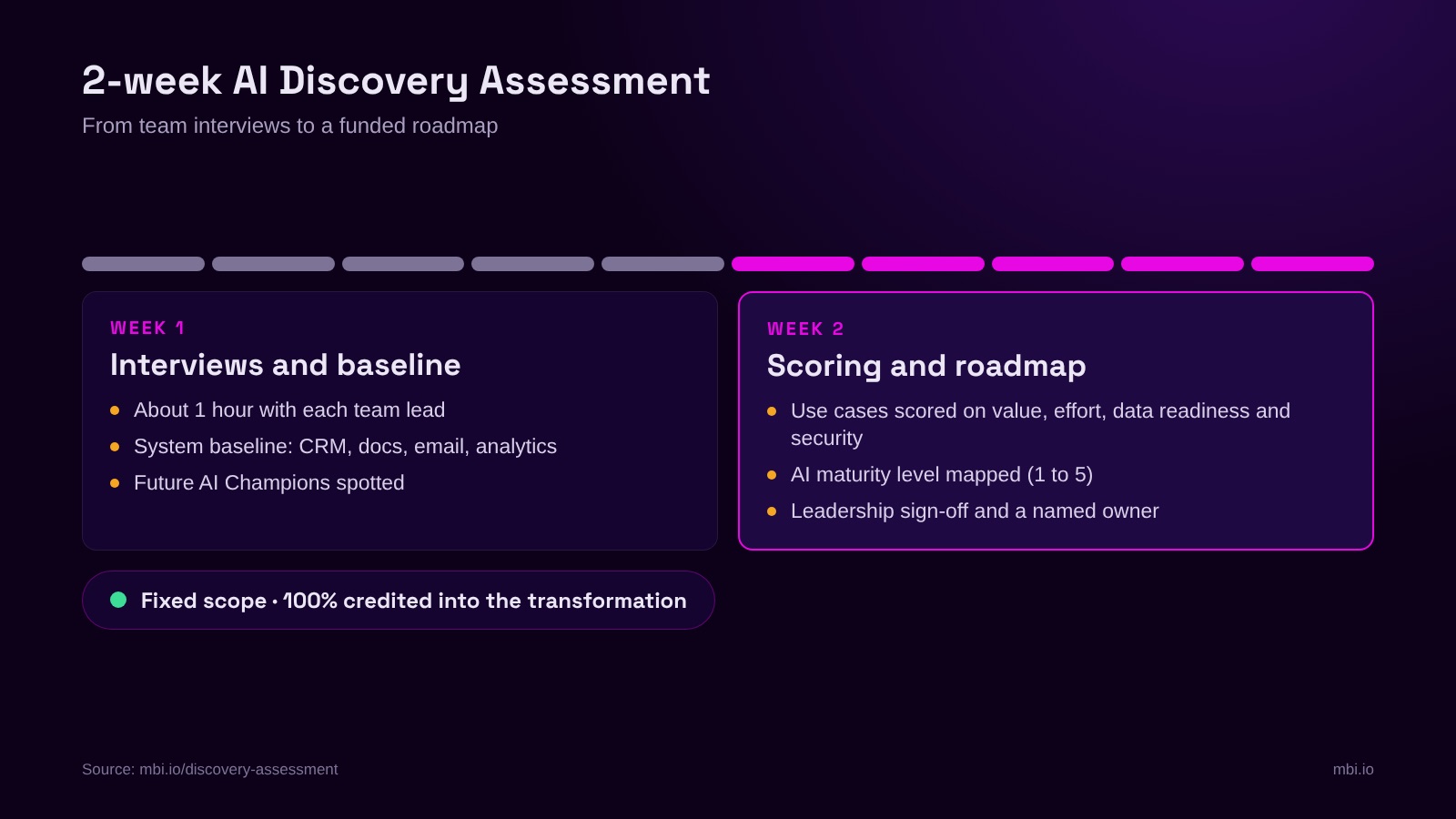
Week 1: team interviews and system baseline
MBI spends about one hour with the lead of each team in scope to map how work actually moves through the company:
- How does work flow from request to delivery today?
- Where do teams lose hours on repetitive, manual tasks?
- Which three to five people does everything route through?
- Where does work stall, and who is it waiting on?
- Where are employees already using AI, and how?
In parallel, MBI looks at the systems the company already runs, such as the CRM, internal documentation, email and analytics, to check what data is there and how good it is. This sets a concrete baseline, so later gains are measured against real numbers rather than guesses. By the end of week 1, MBI also usually knows who the future AI Champions are: the curious people in each team that colleagues already go to for advice.
Week 2: use case scoring and the roadmap
Every opportunity found in week 1 is scored on four criteria:
| Criterion | The question it answers |
|---|---|
| Value | How many hours or how much money does it free up? |
| Effort | How complex is it to build, connect and roll out? |
| Data readiness | Does the data exist, in good enough quality and structure? |
| Security | What sensitive data is involved, and what access controls does it need? |
Use cases are ranked by return and sequenced so that early gains fund the next phases. MBI also places the company on the five levels of AI maturity, so everyone can see the starting point. Week 2 ends with a leadership session where the roadmap is agreed and a named internal owner takes it on.
What do you get at the end of week 2?
- Interview findings and a baseline: findings from every team in scope, plus baseline metrics taken from your own systems.
- AI maturity level: where your company stands on the five levels of AI maturity.
- A scored list of use cases: every opportunity rated on value, effort, data readiness and security, and ranked by return.
- A roadmap leadership can fund: a phased plan with a named internal owner.
You can run the roadmap with MBI, with another partner or with your own team.
What does the assessment need from your team?
- A sponsor from the leadership team, confirmed in writing before the start.
- About an hour with each team lead in week 1.
- Read-only access to the systems needed for the baseline. How MBI handles access and data is described on the security page.
- Your leadership team at the final roadmap session at the end of week 2.
“One thing we agree in writing before we start: who on your side is the business sponsor. Without one, an assessment becomes a PDF nobody acts on.”
Leoš Gerlich, Head of Growth, MBI
How much does an AI Discovery Assessment cost?
The assessment has a fixed scope and a fixed price, and costs less than one senior hire. If you continue with MBI into the transformation, the full price of the assessment is credited into the next phase. There’s no obligation to continue. The exact price for your company is shared on the first strategy call.
What happens after the assessment?
When leadership approves the roadmap, the transformation itself usually takes 3 to 4 months for companies with 30 to 500 employees, starting with the use cases at the top of the list.
At Amazing Places, MBI ran the discovery with the commercial team first, then rolled it out across the company. Three months after the two-week discovery, Amazing Places had 37% more effective employee capacity, with the same team.
Signs your company is ready for an AI Discovery Assessment
- Leadership knows AI can improve how the company works, but not where to begin.
- Employees use AI individually, yet the company’s numbers haven’t moved.
- Earlier AI pilots stalled without reaching daily use.
- Someone in leadership is ready to own the outcome.
If your company isn’t ready for a full assessment yet, start with the 3-minute AI maturity check.
Frequently asked questions
What is an AI Discovery Assessment?
An AI Discovery Assessment is a fixed-scope, two-week diagnostic by MBI for companies with 30 to 500 employees. It maps team workflows and system data, scores AI opportunities by return and security, and delivers a roadmap leadership can fund.
How long does the AI Discovery Assessment take?
Exactly two weeks. Week 1 covers team interviews and the baseline. Week 2 covers use case scoring, ranking by return and a final roadmap session with leadership.
How much time does it need from our people?
About one hour with each team lead in week 1, a sponsor from the leadership team, access to the systems needed for the baseline, and leadership at the final session in week 2.
What do we get at the end?
Findings from the interviews, a baseline from your systems, your level on MBI’s five levels of AI maturity, a ranked list of scored use cases, and a roadmap with a named internal owner.
Do we have to continue with MBI afterwards?
No. You own all the findings and can run the roadmap on your own or with any partner. If you continue with MBI, the full price of the assessment is credited into the next phase.
How much does the assessment cost?
The price is fixed and fully credited if you continue with MBI. Book a strategy call for a quote for your company.
Get new articles by email
Practical guides on making AI work in your company, from the MBI team. Unsubscribe anytime.
Thanks, you're subscribed.
That didn't work. Please try again, or write to [email protected].
Privacy policy