MBI team
November 20, 2026 · 8 min read
Amazing Places, a hospitality e-commerce company with 32 people, gained 37% more effective employee capacity in three months, with the same team. 97% of the company now uses AI, and 82% use it every day. It took a 2-week discovery and a 3-month transformation across six teams, and no system had to be replaced.
This is how it went, what people do differently now, and what made it stick.
| Company | Amazing Places, hospitality e-commerce, Central Europe |
| People | 32, about 30 in scope across 6 teams |
| Timeline | 2-week discovery, then 3 months of transformation |
| Result | +37% effective capacity, 97% adoption, 82% daily use |
| Who runs it now | Internal AI Champions |
No crisis to fix
Amazing Places connects customers with selected accommodation partners. When they came to us, nothing was broken. The business was doing well, and the management team expected AI to change the economics of digital businesses. They wanted to move first.
“The hardest part wasn’t technical. It was the decision to start while things were going well.”
Jan Kadlecek, CEO and founder, MBI
Starting from strength made a difference. People weren’t fixing a problem under pressure; they had room to learn.
Where they started
- Much of the work in account management, marketing, sales, support and the back office was manual.
- Know-how sat with a few senior people.
- There was no central knowledge base and no standard way of documenting processes.
- Some people already used AI, on personal accounts.
The company ran on eight systems, none of them talking to each other: Raynet for the CRM, Ecomail for newsletters, Google Workspace, their own customer data platform, Datalook and a data warehouse for analytics, Fireflies for meetings, documentation spread across Jira, Confluence and Notion, and assorted AI tools on personal accounts. Every system did its job. They just didn’t add up to one.
Two weeks of discovery
The commercial team went first, then the rest of the company followed: account managers, sales, marketing, support and back office, project management, and leadership. Every opportunity was ranked by its return, so the roadmap started with the changes that mattered most, not the ones that were easiest to show.
Three months of transformation
Three decisions shaped the project.
1. Keep and connect. No system was replaced. The CRM stayed the CRM, the newsletter tool stayed, and so did their own customer data platform and the analytics. Replacing a working stack is slow, expensive, and almost never what was actually wrong.
2. Consolidate. Documentation moved from three places into one knowledge layer in Jira and Confluence, built for people and agents alike. Personal AI accounts were replaced by one governed platform with company context. Know-how was written down as processes, starting with the commercial ones, and every workflow got a named owner.
3. Add one layer. An AI hub connected everything: one place for company context and processes, with permissions, logging and oversight. Agents work inside the workflows, and approval stays with a person wherever a decision matters.
Instead of training everyone, we trained trainers. Internal AI Champions learned to build and teach, and they carried it forward.
What it took from the team
An AI transformation isn’t something a partner does to a company. On the Amazing Places side, it needed:
- A business sponsor from the management team, who made decisions quickly and kept it a business priority.
- Time from every team during the two weeks of discovery, mostly interviews and short workshops.
- A small group of internal AI Champions, who set time aside every week to learn to build and teach.
- Time from everyone to learn new ways of working. That’s where the dip in output around month two comes from, and why it’s planned for from the start.
What people do differently now
The numbers below are what people told us in interviews in September 2026, in their own words.
Sales. Václav Vítek, Head of Growth, used to spend 30 minutes analysing and answering a complex email. Now it takes under 5, three times a week. He also no longer waits for colleagues to make his presentations.
“At the start I used AI as an alternative to Google. Now I have schedules that find contacts on LinkedIn for me.”
Václav Vítek, Head of Growth
“I have a skill that goes through my emails, finds the companies we’re discussing partnerships with, checks them against Raynet and adds the missing ones as leads.”
Veronika Dvorská, sales
“I used to not make presentations at all. I had to ask colleagues and then fine-tune them together. Today I can prepare materials for a business event for 200 people on my own, in two to four hours.”
Adéla Jerie, sales
Marketing.
“The weekly report on our PR coverage used to cost me 45 minutes to an hour. Now it’s 10 minutes of checking. And it’s better: because it’s connected to Raynet, it matches each article to the right places and account managers, which I’d never have managed by hand.”
Kateřina Harcubová, marketing
Project management.
“A brief for the developers that would have taken me an hour and a half now takes 30 minutes, every week. Instead of building from scratch, I just check.”
Tereza Krejčíková, project management
One sentence sums up how many people described the change:
“Claude is a colleague who always has time for you.”
Lucie Pultarová
The results
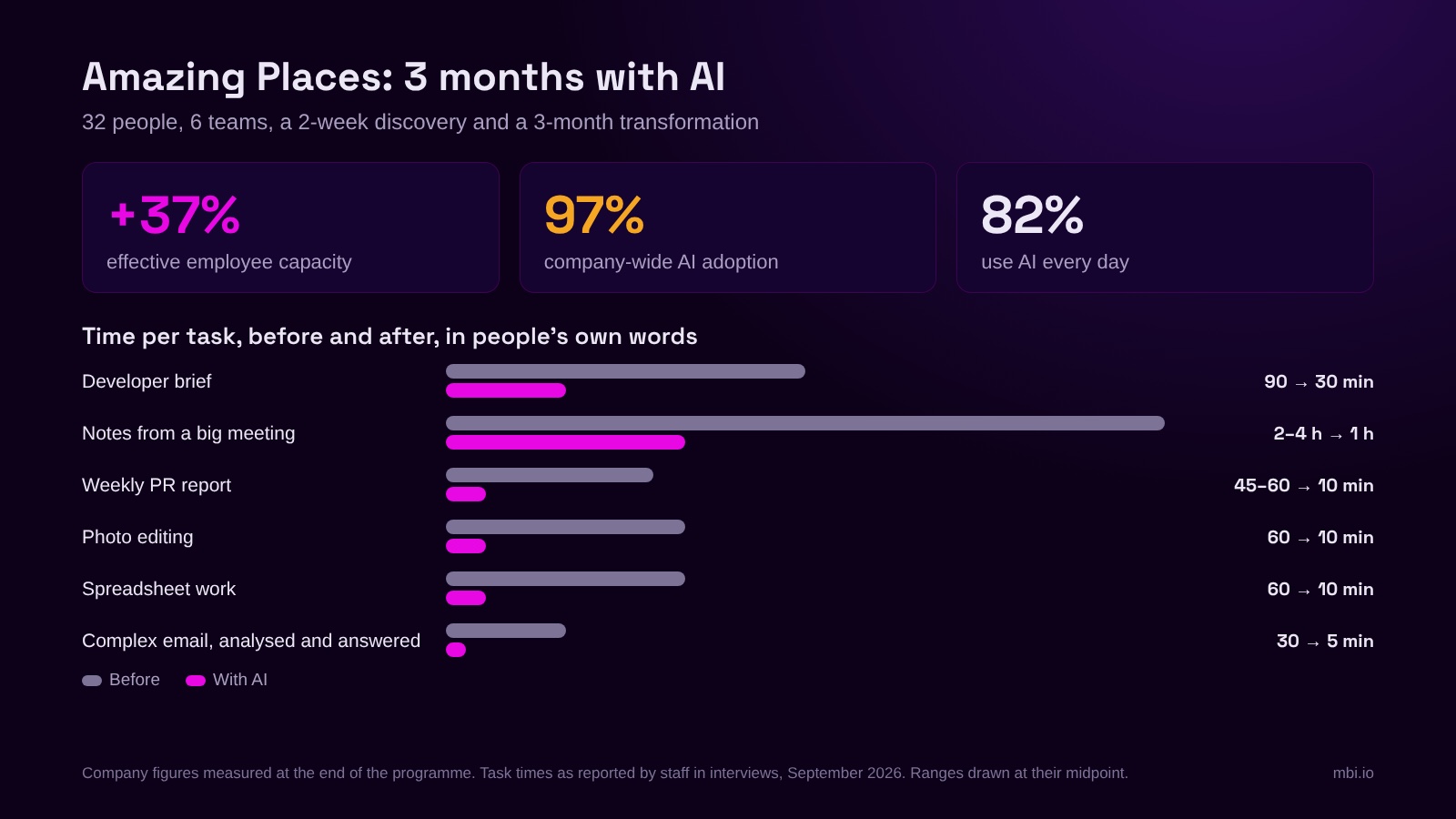
Measured at the end of the programme:
- +37% effective employee capacity across the six teams
- 97% company-wide AI adoption
- 82% use AI every day, not just registered for it
What it meant for the business:
- More partner touchpoints and more marketing output, without more coordination
- Growth absorbed by processes and agents, not by hiring at the same rate
- Less dependence on a few senior people, because the know-how is written down
- A knowledge layer that agents both use and help keep current
The number that matters most is capacity, not adoption. Adoption tells you people logged in. Capacity tells you the company can take on about a third more work with the same team.
What made it work
- Leadership started it, from strength. It was a business decision, not an IT project.
- Processes first, automation second. Nothing was automated before it was written down and owned.
- One knowledge layer for people and agents, instead of documents in three places.
- No new systems. Everything was connected, nothing was thrown away.
- Trainers, not training. Internal champions made it last after we left.
- Measured at the end, not promised at the start. The baseline was set in the discovery.
In terms of the five levels of AI maturity, many people moved from level 1 to level 3: from asking questions in a chat window to AI doing scheduled work inside the company’s systems.
What’s next
The work isn’t finished, and the team knows it. In the interviews, people pointed to the next opportunities themselves: documenting the recurring problems that still cost time, each with a clear owner, and bringing the remaining systems closer together. The difference now is that the company has the people and the setup to do it on its own.
Read the full case study on mbi.io, or see how long an AI transformation takes in general.
Frequently asked questions
What did Amazing Places achieve with AI?
In three months, Amazing Places gained 37% more effective employee capacity with the same team. 97% of the company uses AI, and 82% use it every day.
How long did the AI transformation take?
A 2-week discovery, followed by 3 months of transformation across six teams.
Which teams were involved?
Account management, sales, marketing, support and back office, project management, and leadership. About 30 of the company’s 32 people were in scope.
Did Amazing Places have to replace its systems?
No. The existing systems stayed and were connected. Documentation moved into one knowledge layer in Jira and Confluence, and personal AI accounts were replaced by one governed platform.
Who runs the AI setup now?
Internal AI Champions. They train colleagues and extend the setup without MBI.
What does 37% more capacity mean?
The same team can take on about a third more work without hiring at the same rate.
Want to know what your company could gain? Book a strategy call or take the 3-minute AI maturity check.
Get new articles by email
Practical guides on making AI work in your company, from the MBI team. Unsubscribe anytime.
Thanks, you're subscribed.
That didn't work. Please try again, or write to [email protected].
Privacy policy