MBI team
November 26, 2026 · 8 min read
A Forward Deployed Engineer (FDE) at MBI is an embedded senior AI engineer who works directly inside a client organization, typically two to three days a week on a post-transformation retainer, to turn internal AI fluency into measurable P&L impact. Already familiar with the company's workflows from discovery and transformation, an FDE builds high-ROI automations, drives departmental adoption, and takes direct accountability for business outcomes.
A Forward Deployed Engineer (FDE) at MBI is an embedded senior AI engineer who works directly inside a client organization, typically two to three days a week on a post-transformation retainer, to turn internal AI fluency into measurable P&L impact. Already familiar with the company’s workflows from discovery and transformation, an FDE builds high-ROI automations, drives departmental adoption, and takes direct accountability for business outcomes.
“After a transformation, everyone in the company can work with AI. Someone still has to make sure it shows up in the business.”
Jan Kadleček, CEO, MBI
Where does the term Forward Deployed Engineer come from?
Palantir pioneered the role in the early 2010s. Instead of building software at headquarters and handing it over, Palantir embedded engineers, known internally as “Deltas”, directly inside customer organizations to deploy and adapt the platform on-site. For years, Palantir employed more forward deployed engineers than traditional software engineers (The Pragmatic Engineer).
Major AI labs adopted the same model as enterprise customers moved from isolated experiments to production deployments. OpenAI built its own dedicated FDE team, and Anthropic now trains partner engineers through its official Claude Forward Deployed Engineer learning path on the Anthropic Partner Academy: an eleven-course, 9.5-hour curriculum restricted to companies in the Claude Partner Network.
What stands out in Anthropic’s curriculum goes beyond technical tooling. Alongside modules on the Claude platform, Claude Code and the Model Context Protocol (MCP), it features a delivery methodology course built on a practical reality: technical deployment is the straightforward part. The harder work is qualifying use cases for ROI, scoping pilots, capturing operational baselines, driving user adoption and enabling internal champions. That exact methodology defines how MBI operates.
Why do companies need an FDE after an AI transformation?
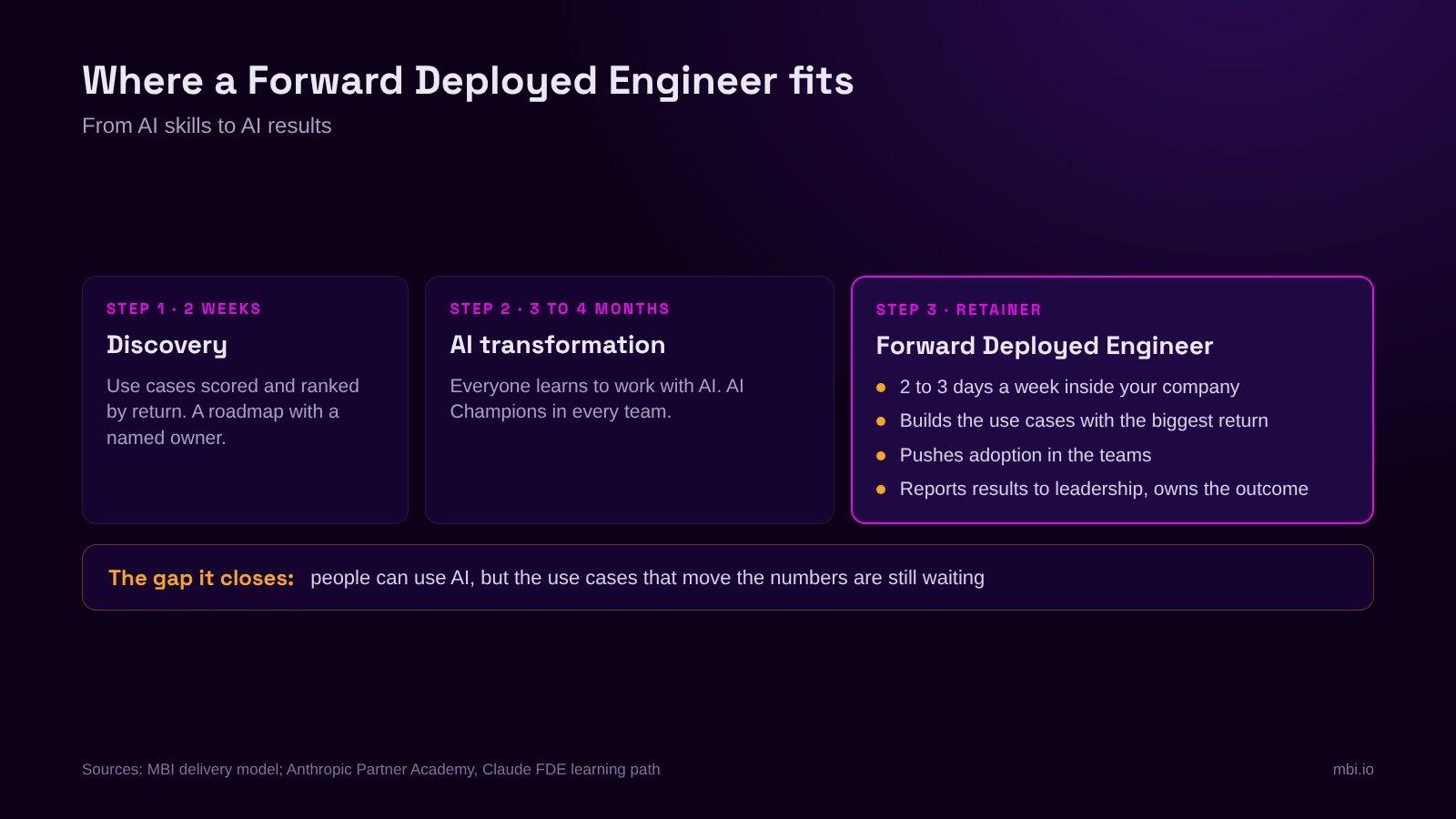
An AI transformation teaches employees how to work with AI. In MBI’s programs, that consists of a two-week AI Discovery Assessment followed by three to four months of hands-on building, training and embedding AI Champions across every department.
At the end of those four months, everyone knows how to use AI. Generating company-wide financial return is a separate step.
Left to their own devices, employees automate whatever task happens to sit in front of them. Someone builds an agent to organize their weekly grocery order: impressive proof that they understand the tools, yet zero impact on company revenue or capacity. Meanwhile, the high-value workflows identified during discovery, such as automating tier-one customer support responses, remain stuck in the backlog because nobody has the dedicated hours, system permissions or mandate to ship them into production.
An FDE closes that execution gap.
What does an MBI Forward Deployed Engineer do?
An MBI Forward Deployed Engineer works inside your company two to three days a week as an ongoing retainer following your AI transformation. In practice, they:
- Start with full operational context: having participated in your discovery and transformation, they already know your team leads, internal systems and ROI-scored use case backlog.
- Own the highest-ROI use cases: that stalled customer support automation becomes their direct deliverable, complete with a launch date and target metrics.
- Build and coach in parallel: they engineer production automations and agents themselves while pushing teams to adopt the tools and build their own workflows.
- Report directly to leadership: they communicate progress in business metrics and align upcoming priorities with the executives who own the P&L.
- Take accountability for outcomes: their performance is measured by documented changes in operational numbers and team capacity.
“Our forward deployed engineer already knows everyone in your organisation and how it works. They can talk to leadership, they have technical credibility, and they’re accountable for the results.”
Jan Kadleček, CEO, MBI
How is an FDE different from a consultant, a contractor or a new hire?
| Dimension | Traditional consultant | External contractor | Full-time new hire | MBI Forward Deployed Engineer |
|---|---|---|---|---|
| Knows your company | From surface interviews | No | After months | Yes, from discovery and transformation |
| Builds production systems | No, delivers recommendations | Yes, strictly to a written spec | Yes | Yes, collaboratively with teams |
| Drives team adoption | No | No | Occasionally | Yes, hands-on across departments |
| Answers for business ROI | No | No | Indirectly | Yes, measured on business numbers |
| Time to impact | Slow | Depends on spec clarity | Months of onboarding | Fast, no onboarding needed |
What do Anthropic’s certifications say about who should do this work?
Anthropic certifies practitioners who build with Claude across three distinct roles: Associate, Developer and Architect, each progressing from Foundations to Professional level through proctored, identity-verified Pearson exams (Anthropic).
The official FDE learning path builds competencies aligned with the Developer level. Architect sits a tier above it, validating engineers who design end-to-end Claude systems, including enterprise integration architecture, data governance and evaluation frameworks.
MBI is a member of the Claude Partner Network, and more than ten of our engineers hold the Claude Certified Architect credential. When MBI embeds an FDE into your organization, you get an engineer certified above the baseline role requirement, backed by a team of architects who have deployed similar production systems across other mid-sized companies.
Five signs your company needs a Forward Deployed Engineer
- Employees use AI daily, yet company-wide financial and capacity metrics remain unchanged.
- High-ROI use cases scoped during your transformation are still sitting in the backlog.
- Your internal AI Champions are maxed out supporting colleagues and lack bandwidth to build complex automations.
- Leadership wants to prove the ROI before committing to a permanent senior AI engineering hire.
- Executives want a single accountable owner for AI business results.
Haven’t started an AI transformation yet? Begin with MBI’s two-week AI Discovery Assessment, or take the 3-minute AI maturity check.
Frequently asked questions
What is a Forward Deployed Engineer?
A Forward Deployed Engineer (FDE) is an embedded AI engineer who works directly inside a client company. They understand internal workflows, build production automations, drive team-wide adoption, and take direct accountability for measurable business outcomes.
Where does the term Forward Deployed Engineer come from?
Palantir created the role in the early 2010s to deploy software on-site inside customer organizations. Enterprise AI leaders including OpenAI and Anthropic later adopted the model, with Anthropic offering a dedicated Claude Forward Deployed Engineer learning path for partners.
How is an FDE different from a traditional consultant?
A traditional consultant audits operations, delivers a slide deck of recommendations, and leaves. An FDE stays embedded inside the company, builds production systems alongside internal teams, and is measured on real operational results.
When does a company need an FDE?
Companies typically bring in an FDE right after an AI transformation, when staff know how to use AI tools, but high-impact departmental automations require dedicated engineering ownership to reach production.
How much of an FDE’s time does a company get?
At MBI, an FDE typically works inside your organization two to three days per week on a flexible retainer following your AI transformation.
Are MBI’s engineers certified by Anthropic?
Yes. More than ten engineers at MBI hold the Claude Certified Architect certification, Anthropic’s role-based credential for designing and governing end-to-end Claude solutions.
Sources
- Anthropic. Claude Forward Deployed Engineer (learning path). Anthropic Partner Academy. anthropic-partners.skilljar.com/path/claude-fde (partner sign-in required). Accessed 26 November 2026.
- Anthropic. Four role-based certifications for the people who put Claude to work for customers. Claude blog, 23 July 2026. claude.com/blog/four-role-based-claude-certifications
- Anthropic. Partner certifications. Anthropic Partner Academy. anthropic-partners.skilljar.com/page/partner-certifications
- Orosz, Gergely. What are Forward Deployed Engineers? The Pragmatic Engineer, 12 August 2025. newsletter.pragmaticengineer.com/p/forward-deployed-engineers
Get new articles by email
Practical guides on making AI work in your company, from the MBI team. Unsubscribe anytime.
Thanks, you're subscribed.
That didn't work. Please try again, or write to [email protected].
Privacy policy