MBI team
November 13, 2026 · 7 min read
For a company with 30 to 500 employees, a comprehensive AI transformation takes 3 to 4 months, preceded by a 2-week discovery assessment.
Quick facts: AI transformation benchmark (30 to 500 employees)
- Total timeline: 3.5 to 4.5 months (assessment through autonomous handover)
- Discovery phase: 2 weeks (workflow audit, baseline metrics, ROI-ranked roadmap)
- Implementation phase: 3 to 4 months (agent integration, change management, J-curve recovery)
- Expected adoption: over 90% company-wide engagement within 90 days
- Primary bottleneck: the month-two operational dip (learning curve friction)
This duration covers systemic behavioral change, re-architecting how teams execute daily work, rather than simply rolling out software licenses. Standalone software builds or legacy rewrites follow different delivery cycles, typically ranging from 6 weeks to 4 months.
The 3-phase transformation framework
| Phase | Duration | Core deliverables and milestones | Primary bottleneck / risk |
|---|---|---|---|
| Phase 1: Discovery Assessment | 2 weeks | Operational bottleneck audit; data cleanliness check; ROI-ranked opportunity roadmap. | Absence of an appointed, authoritative business sponsor. |
| Phase 2: Operational Rollout | 3 to 4 months | Standard Operating Procedures (SOPs) documented; unified AI governance layer deployed; custom agent integration; team enablement. | The month-two J-curve: temporary output decline while teams unlearn manual habits. |
| Phase 3: Handover and Scale | Ongoing | Designated internal AI Champions assume full operational ownership; recurring external dependencies removed. | Knowledge siloing if prompt patterns and agent designs are not documented. |
Phase 1: The 2-week Discovery Assessment
Before evaluating tools or signing software licenses, the AI Discovery Assessment establishes operational reality:
- Week 1 (Workflow audit and baseline): We analyze departmental routines across all teams in scope. Where is manual work creating latency? What shape is your internal data actually in? We establish hard operational baselines so downstream ROI can be audited objectively.
- Week 2 (Valuation and prioritized roadmap): Opportunities are evaluated against potential return and execution complexity. You receive a concrete roadmap prioritizing the 2 to 3 highest-yield workflows at the top.
Operational requirement: Kickoff requires a designated business sponsor on the client executive team. Without executive ownership, assessment findings remain inactive strategy decks.
Phase 2: 3 to 4 months of operational transformation
In this phase, operations shift from manual friction to supervised automation:
- Process standardization: Workflows are documented and assigned an accountable owner before automation begins.
- Unified AI governance layer: AI is implemented as a single, governed layer integrated into your existing systems, not a rip-and-replace project.
- Agent integration and enablement: Autonomous agents handle high-volume repetitive work, while staff are trained to prompt, inspect, and supervise their outputs.
Real-world client benchmarks:
- Amazing Places (hospitality e-commerce, about 30 staff across 6 teams): 2 weeks of discovery and 3 months of transformation delivered +37% effective operating capacity, 97% company-wide AI adoption, and 82% daily active use.
- Kalorické tabulky (nutrition SaaS): A 4-month rollout increased regular usage from 48% at kickoff to 97% of staff using AI at least 7 times per week, with 100% of people active every month.
“Analysing and replying to a complex email used to take me 30 minutes. Now it’s under 5, and that’s three times a week. For presentations I used to wait for colleagues and take up their time. Now I do everything myself and save hours for me and for them.”
“At first I used AI as an alternative to Google. Now I have scheduled tasks that find contacts on LinkedIn for me.”
Václav Vítek, Head of Growth, Amazing Places
Expect the month-two productivity dip (the J-curve)
Every operational transformation follows a predictable J-curve. Around weeks 6 to 8, aggregate team output temporarily dips below historical levels.
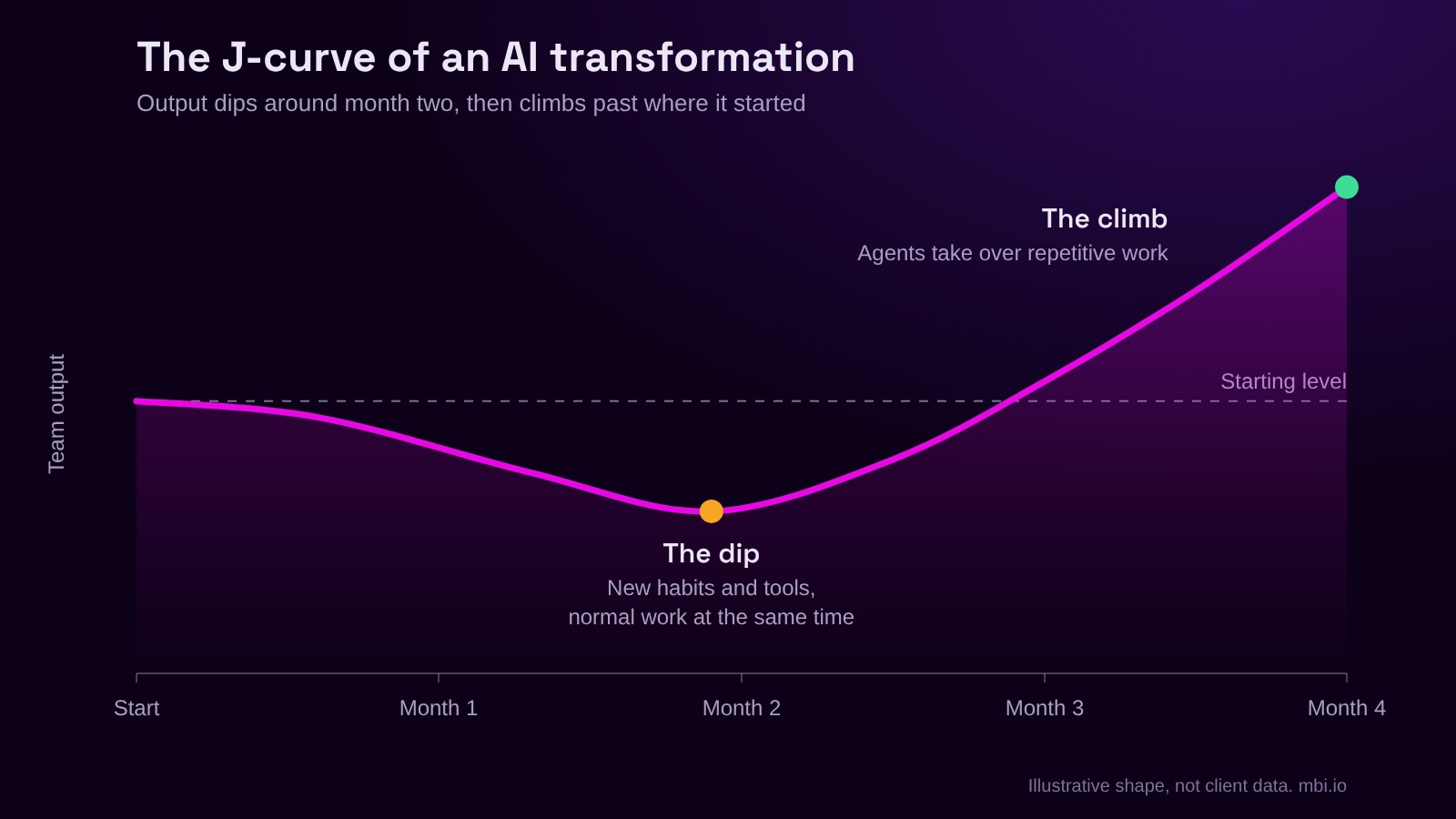
This drop occurs because employees are juggling new workflows while still handling day-to-day work through legacy habits. It signifies active behavioral change, not failure. By month three, as agent workflows stabilize and teams build prompting proficiency, productivity surges well past the original baseline.
Flagging this dip on day one protects the initiative from premature cancellation by uninformed leadership.
Phase 3: Handover and self-sufficiency
A transformation is complete when your internal organization runs and expands the system independently. At Amazing Places, internal AI Champions lead peer onboarding and independently configure new agents. The target is always permanent internal capability, not an open-ended agency retainer.
Organizational transformation vs. custom AI software builds
Transforming day-to-day organizational workflows requires 3 to 4 months. Building dedicated, agentic software follows separate engineering cycles:
- Greenfield product delivery: Veverka Ventures went from first concept to a production-ready product in 6 weeks, on about 50 human hours across both teams.
- Legacy platform modernization: A complete rebuild of the 15-year-old Affilbox platform using AI delivery methods took 3 months (compared to an estimate of 14+ months for a conventional rebuild).
Why timelines differ by company size
- Under 30 people: Often takes 6 to 8 weeks due to flat organizational structures and rapid decision loops.
- 30 to 500 people (our core focus): Takes 3 to 4 months. Formal change management and governance are required, but leadership remains agile enough to avoid procurement gridlock.
- 500+ enterprise: Typically takes 12 to 18+ months due to multi-tiered security sign-offs, regulatory requirements, and complex ERP integrations.
The 4 main causes of transformation delays
- Absence of a business sponsor: Approvals stall across departmental boundaries.
- Tribal knowledge: Core operating procedures live solely in key employees’ heads rather than accessible documentation.
- Tool-first procurement: Purchasing software licenses before identifying the root operational bottleneck.
- Missing baselines: Inability to measure or prove business value post-rollout.
Frequently asked questions
How long does an AI transformation take for a mid-sized business?
For companies with 30 to 500 employees, a complete AI transformation typically takes 3 to 4 months following a 2-week discovery assessment.
How long does the AI Discovery Assessment take?
The discovery assessment takes two weeks: Week 1 maps workflows, data readiness, and performance baselines; Week 2 delivers an ROI-ranked execution roadmap.
When do measurable results appear during an AI rollout?
Performance baselines are tracked from week one. Teams typically experience a temporary performance dip in month two (the J-curve) before climbing above baseline by month three.
Do you need to replace existing systems for an AI transformation?
No. AI is deployed as a secure, governed operational layer directly over your existing technology stack and database environment.
What happens once the transformation project concludes?
Your internal team takes full ownership. We train designated internal AI Champions and functional owners to maintain, govern, and expand agents independently.
Ready to map out your company’s timeline? Take the 3-minute AI Maturity Check or book a strategy session.