MBI team
November 20, 2026 · 8 min read
The five levels of AI maturity are prompting, context, execution, orchestration and autonomous: from people trying AI on their own (level 1) to AI handling much of the routine work under your control (level 5). In our conversations with companies, most are at level 1 or 2. Returns start at level 3, and the way the company works really changes at level 4.
Asking “are you using AI?” gets a yes from almost everyone, because a few people have ChatGPT open in a browser tab. The more useful question is: what does AI actually do in your company?
The five levels at a glance
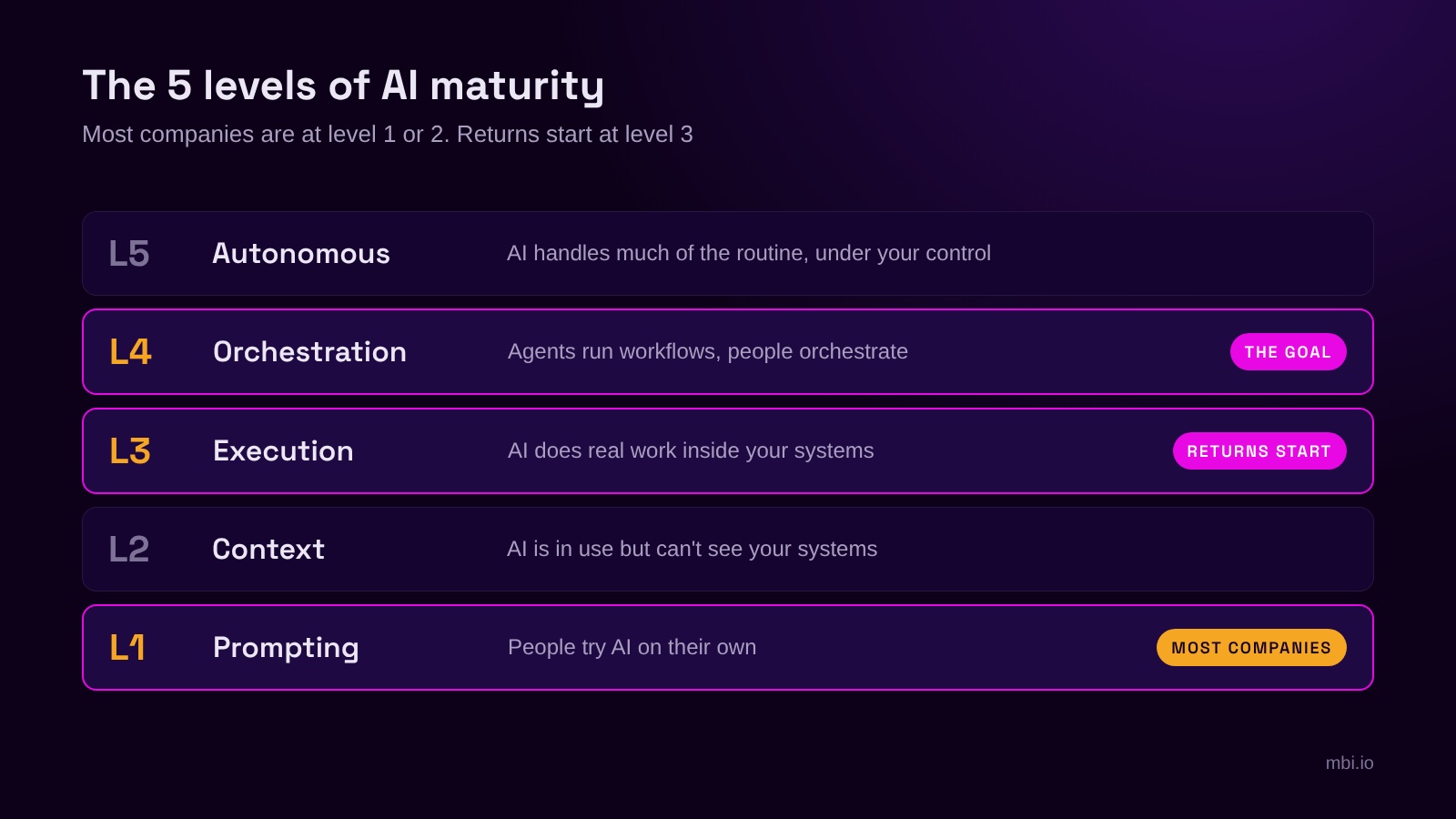
| Level | What it means | What a normal Tuesday looks like |
|---|---|---|
| 1. Prompting | People are trying AI on their own | Someone drafts an email or summarises a meeting in a chat window |
| 2. Context | AI is in use, but it can’t see your systems or your company knowledge | Answers are fluent but generic, and people copy-paste company data in by hand |
| 3. Execution | AI does real work inside your systems | AI reads and writes into your tools: drafts a support reply from the ticket history, updates the CRM |
| 4. Orchestration | Agents run whole workflows and people orchestrate them | A team lead runs several agents, each with a named human owner |
| 5. Autonomous | AI handles much of the routine work, under your control | Agents work inside guardrails; people check and correct instead of doing |
Level 1: prompting
People use AI on their own, usually on private or individual accounts. It helps with writing and research, but the company works exactly as before, and nobody can say what changed in the numbers.
You’re here if: AI use depends on who is curious, and there is no shared way of working with it.
Level 2: context
AI is officially in use, maybe with company licences, but it can’t see your documents, history or systems. People paste data in by hand, and the answers stay generic.
You’re here if: people say “it’s useful, but it doesn’t know how we do things here”.
Level 3: execution
This is where returns start. AI stops advising and starts doing real work inside your systems: reading tickets, drafting replies, updating records, preparing reports from live data.
At Kalorické tabulky, the share of people whose AI does work for them, with scheduled tasks and skills connected to company systems, rose from 43% to 86% in three months.
The same move, seen from one person at Amazing Places:
“At the start I used AI as an alternative to Google. Now I have schedules that find contacts on LinkedIn for me.”
Václav Vítek, Head of Growth, Amazing Places
That is level 1 to level 3 in two sentences: from asking questions in a chat window to AI doing scheduled work on its own.
You’re here if: you can name workflows where AI does a step end to end, and someone checks the result.
Level 4: orchestration
The way the company works changes. People run teams of agents, agents run whole workflows, and every agent has a named human owner who is accountable for what it does. Knowledge is written down, so it doesn’t leave with people.
At Amazing Places, this is what 37% more effective employee capacity in 3 months looked like: processes written down and owned, one knowledge layer that people and agents both use, and internal AI Champions carrying it forward.
You’re here if: growth no longer means hiring at the same rate.
Level 5: autonomous
Agents handle much of the routine work inside clear guardrails, and people validate and correct instead of executing. Few companies need to be here everywhere. For most, level 4 is the goal, with level 5 in a few high-volume workflows.
One workflow, five levels: answering a customer email
The levels are easiest to see in one everyday task. Here is the same customer email at each level:
| Level | What happens |
|---|---|
| 1. Prompting | An agent pastes the email into a private chat window and asks for a polite reply |
| 2. Context | The company tool knows the tone of voice and the product, but the agent still copies in the order details by hand |
| 3. Execution | A draft reply is ready in the ticket before the agent opens it, built from the order history and the knowledge base. The agent checks it and sends it |
| 4. Orchestration | Agents sort incoming emails, draft replies, flag refunds for approval and update the CRM. A team lead owns the agents and handles the exceptions |
| 5. Autonomous | Routine questions are answered within agreed rules; people review a sample and deal with the unusual cases |
A quick self-check
Answer yes or no. Your first “no” shows the level you haven’t reached yet, so you’re usually one level below it. A “no” to question 1 means you haven’t really started.
- Do people use AI in their work every week? (level 1)
- Does the company provide approved AI tools, under a business contract? (level 2)
- Can those tools see your documents, history and company knowledge? (level 2)
- Is there at least one workflow where AI does a step end to end inside your systems? (level 3)
- Do you measure what AI changes, against a baseline? (level 3)
- Does every agent have a named owner? (level 4)
- Are your main processes written down and owned? (level 4)
- Could you take on noticeably more work without hiring at the same rate? (level 4)
For a more precise answer, with a next step for your level, take the AI maturity check.
Why most companies stay at level 1 or 2
“Technology is the easy part now. Anyone can buy licences by Friday. The hard part is everything around them: habits, roles, who decides what. That’s why moving up a level is a leadership decision, not an IT one.”
Jan Kadlecek, CEO and founder, MBI
Companies get stuck for the same reasons:
- AI arrives through individuals, not through a decision
- processes and know-how aren’t written down, so there’s nothing for AI to work with
- AI is treated as an IT project, without a business sponsor
- nobody set a baseline, so nobody can prove the step up was worth it
How to move up
- Find out where you are. Be honest: most companies start at level 1 or 2.
- Pick the workflows that pay off most, ranked by return, not by what’s easiest to demo.
- Write the processes down and give them an owner before automating anything.
- Connect AI to your systems in one governed layer, so it can reach level 3.
- Train internal champions so the move to level 4 lasts after the project ends.
For a company with 30 to 500 people, getting from level 1 or 2 to level 4 usually takes 3 to 4 months after a 2-week AI Discovery Assessment. Read more about how long it takes.
Moving from level 1 to level 2 is mostly a purchase and can happen quickly. The real work is the move to levels 3 and 4, because that’s where processes, systems and habits change.
Common mistakes when moving up
- Skipping a level. Building agents (level 4) before AI can see your company knowledge (level 2) gives you fast agents with generic answers.
- Counting licences instead of use. Licences tell you who could use AI. Adoption and capacity tell you what changed.
- Starting with the most impressive demo. Start with the workflow that pays off most, even if it’s unglamorous.
- Agents without owners. Without a named owner, nobody fixes an agent when it drifts, and trust drops fast.
- Stopping at the project’s end. Without internal champions, companies can slide back a level.
Frequently asked questions
What are the 5 levels of AI maturity?
Prompting, context, execution, orchestration and autonomous. They go from people trying AI on their own (level 1) to AI handling much of the routine work under your control (level 5).
What level are most companies at?
In our experience, most companies are at level 1 or 2: people use AI on their own, or AI is in use but can’t see the company’s systems and knowledge.
At which level does AI start to pay off?
At level 3, when AI stops advising and starts doing real work inside your systems.
Do we need to reach level 5?
Usually not everywhere. For most companies level 4 is the goal, with level 5 in a few high-volume workflows.
Can we skip a level?
Not really. Each level builds on the one before: agents (level 4) need AI that can see your systems and knowledge (levels 2 and 3), or they produce generic results.
Is a company ChatGPT or Copilot licence level 2?
Usually yes. A company licence makes AI official, but until it can see your documents, history and systems, and do work inside them, you’re at level 2.
How do we find out our level?
Take the 3-minute AI maturity check on mbi.io. You answer seven questions and get your level from 1 to 5 in each area, with a PDF report of practical first steps.
Where is your company today? Take the 3-minute AI maturity check or book a strategy call.
Get new articles by email
Practical guides on making AI work in your company, from the MBI team. Unsubscribe anytime.
Thanks, you're subscribed.
That didn't work. Please try again, or write to [email protected].
Privacy policy